
Minoxidil Before and After: Real Results, Timeline & a Natural Alternative

Minoxidil before and after photos sell a promise that the timeline behind them rarely explains: real change is measured in months, and it usually starts with more shedding before it looks like more hair. If you are searching for what a genuine transformation looks like, the honest answer is that minoxidil can work for the right type of hair loss, but only with consistent daily use over four to six months, and only for as long as you keep applying it. This guide walks through the real month-by-month timeline, the shedding phase that scares people into quitting early, the side effects and brand differences, and where a natural, follicle-supporting alternative fits for those who want something they can sustain.
Before comparing products, it helps to understand that hair loss is a symptom with many causes, and no single treatment fits all of them. For a fuller picture of how Primadar and minoxidil differ in mechanism and suitability, see our detailed guide on the difference between Primadar and minoxidil. Here, the focus is practical: what actually happens once you start, and how to read your own results honestly.
Looking for a way to support your follicles from the inside during your hair journey?
Primadar: natural support for your hair from the rootMinoxidil Before and After: The Honest Quick Answer
The quick answer is that a real before-and-after difference is possible, but it is neither fast nor permanent. Minoxidil is a topical treatment that stimulates hair follicles, and it works best on hair loss at the crown and thinning areas where follicles are still alive but shrinking. It does not repair a fully bald, scarred scalp, and it does not fix a nutritional, hormonal or thyroid cause on its own. So the honest framing is: if your follicles are still active and you commit to daily use for months, you can expect reduced shedding and some regrowth of finer hairs that gradually thicken.
The catch that the photos never show is dependence. Minoxidil supports growth only while you use it. Stop, and the gains typically fade over the following months. That single fact reshapes the whole decision, because it turns a product into a permanent routine. This is exactly why many people start looking for a gentler, sustainable option they can keep up long term, whether as a standalone approach for mild cases or as support alongside other care.
Minoxidil Before and After Timeline: Month by Month
Understanding the minoxidil timeline is the single best defence against quitting too early. Hair grows on a biological cycle, so the treatment cannot show results faster than the follicle can physically produce hair. Here is what a typical, realistic progression looks like with consistent daily application.
Weeks 1 to 8: This is the phase that frightens people. Many users notice more shedding, not less, as minoxidil pushes resting follicles out of their dormant phase. The scalp may look worse before it looks better. This is often a sign the treatment is acting, not failing, though it is not guaranteed for everyone.
Months 2 to 4: Shedding usually settles. Fine, short new hairs begin to appear along the hairline and thinning zones. They are easy to miss because they are soft and light, and progress at this stage is best tracked with fixed-lighting photos rather than the mirror.
Months 4 to 6: This is where a visible before and after typically emerges. Those fine hairs thicken and lengthen, density improves, and the overall look begins to change. Most honest before-and-after comparisons are taken at this point, not at week three.
Months 6 to 12: Results mature and stabilise. What you see here is roughly what continued use will maintain. Crucially, maintenance is the operative word: this is the level you hold only by continuing, not a finish line you cross and then walk away from.

What Real Minoxidil Before and After Results Show
Genuine before-and-after results tend to share a few honest patterns once you look past the most dramatic marketing images. First, the strongest transformations are usually in people with early to moderate thinning and active follicles, not advanced, fully bald areas. Second, results correlate almost perfectly with consistency: the people with the best photos are the ones who applied it every single day for many months without gaps.
Third, the improvement is often described as increased density and a fuller frame rather than a completely restored hairline in a genetically bald region. Managing that expectation is what protects you from disappointment. If you go in expecting a supplement-and-serum miracle in a few weeks, you will quit during the shedding phase and never reach your own before and after. If you go in understanding the cycle, you give the treatment a fair chance to prove itself.
It is also worth remembering that a before-and-after only tells you what happened, not why the hair was falling in the first place. If the underlying driver is nutritional or hormonal, treating only the surface can leave you chasing the symptom. That is why understanding your cause first, then choosing a treatment that matches it, consistently beats grabbing the most-photographed product.
Want a formula that supports the hair follicle from within, whatever the cause of your shedding?
Browse the Primadar storeSide Effects and the Dreaded Shedding Phase
The early shedding phase is the most misunderstood part of any minoxidil before and after story. It is usually temporary and, paradoxically, a sign the follicles are cycling. But it is not the only reaction to know about. Minoxidil can also cause scalp dryness, itching, flaking and irritation, and in some people unwanted facial hair growth or, less commonly, changes linked to its effect on blood vessels, since minoxidil was originally a blood-pressure medication.
The mechanism behind both the benefits and the side effects is well documented. As the medical reference StatPearls on the NCBI Bookshelf explains, minoxidil opens ATP-sensitive potassium channels and shortens the resting (telogen) phase, prompting follicles to re-enter the growth (anagen) phase. That same systemic action is why anyone with a heart condition, low blood pressure, or who is pregnant or breastfeeding should consult a doctor or pharmacist before starting, and why you should stop and seek advice if you develop dizziness, a racing heartbeat, chest discomfort, or severe scalp reactions. Treat any product that ignores these cautions with suspicion.
Foams, MUP and Brands: 5% Foam, Kirkland, Regaine and More
Once you decide to try it, the next confusion is the sheer number of brands. Minoxidil comes as a liquid solution and as a foam. A minoxidil 5 foam and the term minoxidil MUP (minoxidil unified percentage) refer to foam formulations that dry quickly and skip the propylene glycol found in many liquids, which is why a lot of users find a regaine foam or a generic foam less irritating than the drops.
The brand names change by country and price point, but the active ingredient does not. You will see Kirkland minoxidil 5 and Rogaine minoxidil 5 as the well-known international options, alongside regional and generic products such as minoxigrow, hairgrow minoxidil 5, growplex minoxidil foam and hair plus back foam. Whether you reach for regaine or a budget generic, the mechanism, the timeline and the shedding phase are essentially the same, so the choice usually comes down to cost, availability and how the base feels on your scalp. What none of these brands change is the core limitation: they all stimulate from the outside and all stop working when you stop applying them.
A Natural Alternative: How Primadar Supports the Follicle
This is where an oral, follicle-supporting approach becomes worth understanding. Instead of stimulating the scalp topically, a well-designed supplement feeds the follicle the building blocks it needs from the inside. For hair loss tied to poor nutrition or an exhausted follicle, that can be a gentler and more sustainable path, either on its own for milder cases or as support alongside other care. If you want to see where a natural option is enough and where it is not, our article on whether safe natural hair-loss pills exist lays out the honest boundaries.
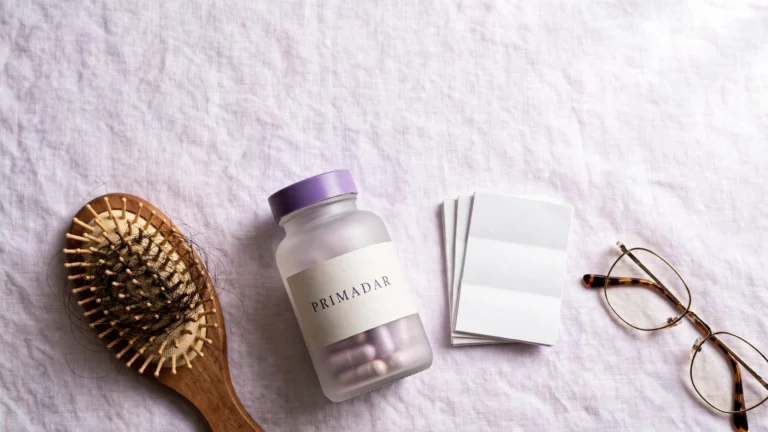
Primadar is built on this idea. It combines Miliacin, a triterpenoid extracted from millet seed, with biotin, vitamin B5 and L-cysteine, so the follicle is supported through more than one pathway at once: Miliacin to encourage growth activity at the source, biotin and L-cysteine as the keratin building blocks, and vitamin B5 for scalp health. The millet angle is not folklore, either. Research on a millet-and-wheat extract complex published in the peer-reviewed journal Nutrients and available via MDPI reported improved hair condition, adding independent weight to millet extract as a follicle-support ingredient. For a deeper look at how this active works, see our explainer on Miliacin and millet for hair.
In fairness, expectations still belong in the right place. Primadar is a nutritional supplement that supports the follicle and prepares better conditions for growth; it is not a drug that reverses advanced genetic baldness or corrects a hormonal disorder on its own. Like any supplement, it needs months of consistent use, not days, and anyone pregnant, breastfeeding, on other medication, or managing a chronic condition should consult a doctor or pharmacist first. The advantage is sustainability: an affordable, locally made Egyptian supplement is far easier to stay consistent with over the long haul than an imported product or a routine you resent.

A before-and-after photo shows you the result. It never shows you the cause, the timeline, or the day you would have to stop. Choose the routine you can actually sustain.
Topical results also depend on what the follicle is being fed. If you want the nutrition side of this in detail, here are the best oils and foods for hair growth and what the evidence actually supports.
Minoxidil vs Primadar: Side-by-Side
Neither option is universally “better”; they suit different situations. This comparison is a general guide, not a diagnosis, and the right choice still depends on your cause of hair loss and a professional’s input:
| Factor | Minoxidil (topical) | Primadar (oral supplement) |
|---|---|---|
| How it works | Stimulates follicles from the surface of the scalp | Supports the follicle from within with Miliacin, biotin, B5, L-cysteine |
| Best suited to | Active follicles with early to moderate thinning | Shedding linked to poor nutrition or an exhausted follicle |
| Timeline | 4 to 6 months, often with early shedding | Gradual over months of consistent use |
| If you stop | Gains typically shed over the following months | Nutritional support, meant for sustainable long-term use |
| Common drawbacks | Scalp irritation, shedding phase, lifelong dependence | Not a cure for genetic or hormonal causes on its own |
For a full breakdown of which situations favour each option, our dedicated Primadar vs minoxidil comparison goes deeper than a single table can.
Common Mistakes That Ruin Minoxidil Results
The most expensive mistake is quitting during the early shedding phase. People see more hair in the sink at week three, panic, and stop, ending the treatment before the results phase ever begins. Knowing the timeline in advance is the cure for this.
The second mistake is inconsistency. Minoxidil rewards daily use and punishes gaps; a bottle used four days a week will never produce the before and after of one used every day. The third is expecting it to fix the wrong cause, applying foam to a scalp whose real problem is low iron, a thyroid issue, or a hormonal shift that a topical simply cannot address.
The fourth mistake is ignoring the whole system: sleeping poorly, eating badly and stressing constantly while relying on a single product to compensate. Hair responds to the whole picture, internal nutrition included, not to one step in isolation. And the fifth, the riskiest, is self-treating warning signs that actually need a doctor, which is where the next section comes in.
When to See a Doctor Before Starting
Minoxidil is available without a prescription in many places, but that does not make a medical check optional. See a doctor before starting if your hair loss is sudden and rapid, if there are sharply defined bald patches that could signal an autoimmune or fungal condition, or if shedding comes with scalp pain, redness, pus or sores.
You should also get assessed if hair loss arrives alongside general symptoms, such as marked fatigue, unexplained weight change, or menstrual irregularity, because these can point to a thyroid, hormonal or nutritional problem that a topical will not solve. Anyone with a cardiovascular condition or low blood pressure, and anyone pregnant or breastfeeding, should specifically clear minoxidil with a doctor or pharmacist first, given its origin as a blood-pressure drug. The safe rule is simple: rule out a medical cause before committing months to a surface treatment.
Have a question about your specific situation? Talk to us directly.
Ask on WhatsAppDecision Checklist: Is Minoxidil Right for You?
Before you buy anything, answer these five questions honestly; your answers point you toward the right path instead of trial and error:
One: Are your follicles still active in the thinning area, or is it a long-bald, smooth patch? Minoxidil needs living follicles to work on.
Two: Can you realistically commit to daily application for at least six months, indefinitely? If not, a treatment that stops when you stop may frustrate you.
Three: Do you understand and accept the early shedding phase, so you will not quit in week three?
Four: Have you ruled out a nutritional, hormonal or medical cause that a topical cannot fix, ideally with a doctor’s input?
Five: Are you supporting the follicle from the inside with good nutrition and a considered supplement in parallel, or relying on one surface step alone? Combining cause-treatment with internal support is what speeds real results.
Still weighing the options? This comparison of what hair loss treatment actually works puts minoxidil side by side with the main alternatives, so you can see where it wins and where it does not.
Your Result Starts With an Honest Decision
The takeaway from every honest minoxidil before and after is that results are real but slow, they begin with shedding, and they last only as long as you keep going. That trade-off suits some people and not others. If your shedding is tied to nutrition or an exhausted follicle, and you want something you can sustain, Primadar’s blend of Miliacin, biotin, vitamin B5 and L-cysteine is designed for exactly that role: supporting your hair from the root, on its own or alongside other care, without a permanent topical dependence.
Frequently Asked Questions
How long until you see minoxidil before and after results?
Most people see a meaningful minoxidil before and after difference somewhere between four and six months of consistent daily use, not weeks. The first visible change is often more shedding, not less, during the first four to eight weeks, because minoxidil pushes resting follicles into a new growth phase. New hairs then need time to grow long and thick enough to be visible. If you stop early because nothing has happened after a month, you stop before the results phase even begins. Consistency over months is the single biggest factor separating a strong before and after from a disappointing one.
Is the shedding phase on minoxidil normal?
Yes, an early increase in shedding is a common and usually temporary reaction when starting minoxidil. It happens because minoxidil shortens the resting phase and pushes old hairs out so new ones can grow in their place. This shedding typically settles within a couple of months. However, if the shedding is severe, keeps getting worse after two to three months, or is accompanied by scalp pain, redness or irritation, stop and consult a doctor or pharmacist rather than assuming it is normal.
What is the difference between minoxidil foam and MUP?
Minoxidil comes as a liquid solution and as a foam, and MUP simply means minoxidil unified percentage, a foam formulation that spreads and dries quickly without the propylene glycol found in many liquid versions. Many people find foams such as a minoxidil 5 foam or a regaine foam less irritating and easier to apply than the liquid, which is why brands like Kirkland minoxidil 5, Rogaine minoxidil 5 and various regional foams exist. The active ingredient and its mechanism are the same across brands; the differences are in the base, price and how the product feels on the scalp.
Do minoxidil results last if you stop using it?
No. Minoxidil does not cure the underlying cause of hair loss; it stimulates follicles for as long as you keep using it. If you stop, the hair gained through treatment is usually shed over the following months and the scalp gradually returns toward its untreated state. This is why minoxidil is a long-term commitment, and why many people look for a supporting routine they can sustain. Always follow the product instructions and consult a doctor or pharmacist about long-term use.
Is there a natural alternative to minoxidil?
For hair loss driven by poor nutrition or an exhausted follicle, an oral supplement that supports the follicle from within can be a gentler, sustainable option, either on its own for mild cases or alongside other care. Primadar combines Miliacin from millet extract with biotin, vitamin B5 and L-cysteine to support the follicle through more than one pathway. It is a nutritional supplement that supports the follicle, not a drug that treats genetic or hormonal hair loss on its own, and results are gradual over months. Consult a doctor or pharmacist before starting if you are pregnant, breastfeeding, taking other medication or have a chronic condition.